Watch Price
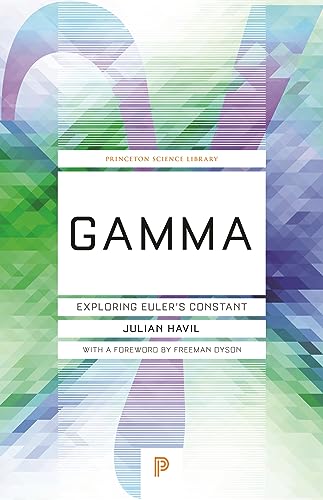
Gamma: Exploring Euler's Constant: 53 (Princeton Science Library, 84)
Among the many constants that appear in mathematics, π, e, and i are the most familiar. Following closely behind is y, or gamma, a constant that arises in many mathematical areas yet maintains a profound sense of mystery.
In a tantalizing blend of history and mathematics, Julian Havil takes the reader on a journey through logarithms and the harmonic series, the two defining elements of gamma, toward the first account of gamma's place in mathematics.
Introduced by the Swiss mathematician Leonhard Euler (1707-1783), who figures prominently in this book, gamma is defined as the limit of the sum of 1 + 1/2 + 1/3 + . . . Up to 1/n, minus the natural logarithm of n--the numerical value being 0.5772156. . . . But unlike its more celebrated colleagues π and e, the exact nature of gamma remains a mystery--we don't even know if gamma can be expressed as a fraction.
Among the numerous topics that arise during this historical odyssey into fundamental mathematical ideas are the Prime Number Theorem and the most important open problem in mathematics today--the Riemann Hypothesis (though no proof of either is offered!).
Sure to be popular with not only students and instructors but all math aficionados,
In a tantalizing blend of history and mathematics, Julian Havil takes the reader on a journey through logarithms and the harmonic series, the two defining elements of gamma, toward the first account of gamma's place in mathematics.
Introduced by the Swiss mathematician Leonhard Euler (1707-1783), who figures prominently in this book, gamma is defined as the limit of the sum of 1 + 1/2 + 1/3 + . . . Up to 1/n, minus the natural logarithm of n--the numerical value being 0.5772156. . . . But unlike its more celebrated colleagues π and e, the exact nature of gamma remains a mystery--we don't even know if gamma can be expressed as a fraction.
Among the numerous topics that arise during this historical odyssey into fundamental mathematical ideas are the Prime Number Theorem and the most important open problem in mathematics today--the Riemann Hypothesis (though no proof of either is offered!).
Sure to be popular with not only students and instructors but all math aficionados,
Product details
Publisher : Princeton University Press; New edition (31 October 2017)
Language : English
Paperback : 296 pages
ISBN-10 : 0691178100
ISBN-13 : 978-0691178103
Item Weight : 272 g
Dimensions : 13.97 x 1.91 x 21.59 cm
Best Sellers Rank: #187,246 in Books (See Top 100 in Books)
#235 in Calculus
#236 in Databases & Big Data
#912 in Physics (Books)
Customer Reviews: 4.4
84 ratings
Publisher : Princeton University Press; New edition (31 October 2017)
Language : English
Paperback : 296 pages
ISBN-10 : 0691178100
ISBN-13 : 978-0691178103
Item Weight : 272 g
Dimensions : 13.97 x 1.91 x 21.59 cm
Best Sellers Rank: #187,246 in Books (See Top 100 in Books)
#235 in Calculus
#236 in Databases & Big Data
#912 in Physics (Books)
Customer Reviews: 4.4
84 ratings
Amazon Price History
This is our record of Amazon price changes for Gamma: Exploring Euler's Constant: 53 (Princeton Science Library, 84) (0691178100) since we began monitoring it.
| Price Type | Lowest Ever | Highest Ever | Current + | Average |
|---|---|---|---|---|
| Amazon | (Aug 08, 2026) | (Aug 08, 2026) | 0,00 € (Aug 08, 2026) |
0,00 €
Amazon Price
Aug 08, 2026 04:44 AM
Your Amazon Price Watches
We'll notify you when the price drops to your desired price.
Watch Price

Watch Price

Watch Price








Watch Price

Watch Price