Watch Price
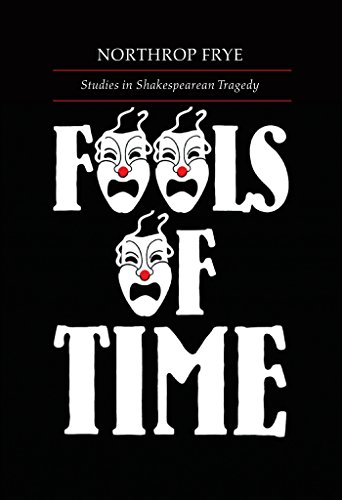
Fools of Time: Studies in Shakespearean Tragedy: Studies in Shakespearian Tragedy (Alexander Lectures)
In the Alexander Lectures for 1965-66 at the University of Toronto, Dr. Frye describes the basis of the tragic vision as "being in time," in which death as "the essential event that gives shape and form to life ... defines the individual, and marks him off from the continuity of life that flows indefinitely between the past and the future."
In Dr. Frye's view, three general types can be distinguished in Shakespearean tragedy, the tragedy of order, the tragedy of passion, and the tragedy of isolation, in all of which a pattern of "being in time" shapes the action. In the first type, of which Julius Caesar, Macbeth, and Hamlet are examples, a strong ruler is killed, replaced by a rebel-figure, and avenged by a nemesis-figure; in the second, represented by Romeo and Juliet, Anthony and Cleopatra, and Troilus and Cressida,
In Dr. Frye's view, three general types can be distinguished in Shakespearean tragedy, the tragedy of order, the tragedy of passion, and the tragedy of isolation, in all of which a pattern of "being in time" shapes the action. In the first type, of which Julius Caesar, Macbeth, and Hamlet are examples, a strong ruler is killed, replaced by a rebel-figure, and avenged by a nemesis-figure; in the second, represented by Romeo and Juliet, Anthony and Cleopatra, and Troilus and Cressida,
Product details
ASIN : B01N22E79M
Publisher : University of Toronto Press (Feb. 6 1996)
Language : English
File size : 392 KB
Text-to-Speech : Enabled
Screen Reader : Supported
Enhanced typesetting : Enabled
X-Ray : Not Enabled
Word Wise : Enabled
Sticky notes : On Kindle Scribe
Print length : 109 pages
Best Sellers Rank: #216,864 in Kindle Store (See Top 100 in Kindle Store)
#27 in History of Drama
#31 in Theatrical History & Criticism
#79 in History of Dramas & Plays
Customer Reviews: 4.7
9 ratings
ASIN : B01N22E79M
Publisher : University of Toronto Press (Feb. 6 1996)
Language : English
File size : 392 KB
Text-to-Speech : Enabled
Screen Reader : Supported
Enhanced typesetting : Enabled
X-Ray : Not Enabled
Word Wise : Enabled
Sticky notes : On Kindle Scribe
Print length : 109 pages
Best Sellers Rank: #216,864 in Kindle Store (See Top 100 in Kindle Store)
#27 in History of Drama
#31 in Theatrical History & Criticism
#79 in History of Dramas & Plays
Customer Reviews: 4.7
9 ratings
Amazon Price History
This is our record of Amazon price changes for Fools of Time: Studies in Shakespearean Tragedy: Studies in Shakespearian Tragedy (Alexander Lectures) (B01N22E79M) since we began monitoring it.
| Price Type | Lowest Ever | Highest Ever | Current + | Average |
|---|---|---|---|---|
| Amazon | (Jun 29, 2026) | (Jun 29, 2026) | 0,00 € (Jun 29, 2026) |
0,00 €
Amazon Price
Jun 29, 2026 08:07 PM
Your Amazon Price Watches
We'll notify you when the price drops to your desired price.
Watch Price
Watch Price



Alexander 3-Book Set: Alexander and the Terrible, Horrible, No Good, Very Bad Day; Alexander Who's N
Watch Price







Watch Price



Watch Price


Watch Price





Watch Price


